Why Your Calm Is One of the Most Powerful Parenting Tools You Have

There is a moment most parents recognize, regardless of their child's age.
Your child is upset. About something at school, a conflict with a friend, a plan that fell through. You try to talk it through. You offer a reasonable explanation. Maybe you point out what they could do differently next time.
And it goes nowhere. If anything, things escalate.
This is not a failure of parenting or your child being disobedient. This is what a still-developing brain looks like in action, and understanding it can change how you approach these situations.
What Is Actually Happening in That Moment
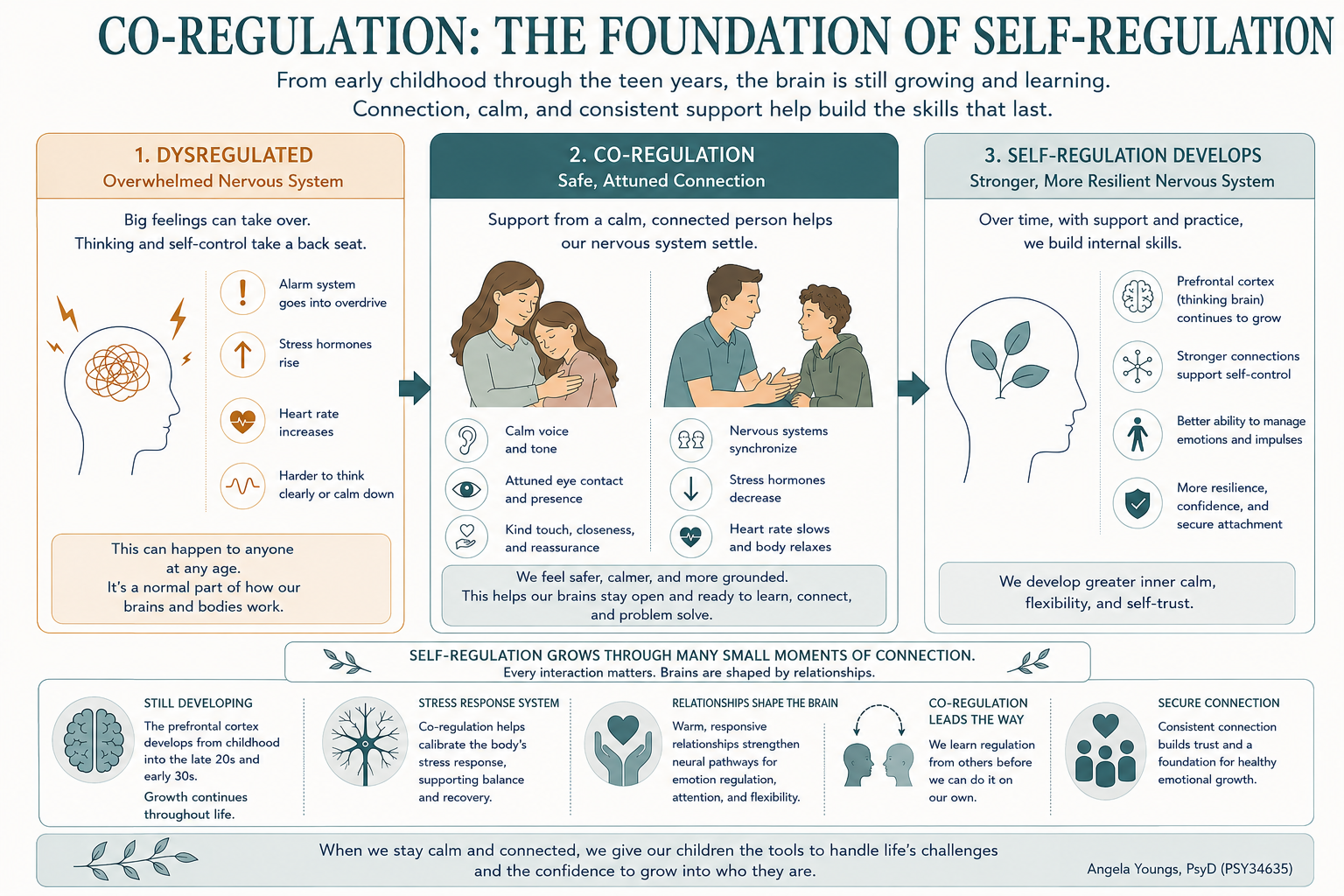
When a child becomes emotionally overwhelmed, the thinking part of the brain temporarily goes offline. The brain's stress response takes over, prioritizing threat detection above everything else. In that state, reasoning, problem-solving, and listening to a calm explanation are simply not available. The nervous system is in a different mode entirely.
This is why talking at a dysregulated child or teen rarely works. The door is closed until the nervous system settles.
What opens the door is something researchers call co-regulation.
The Science of Co-Regulation
Co-regulation refers to the process by which one person's nervous system helps stabilize another's. It sounds simple. It is also backed by decades of research in developmental neuroscience.
From early childhood onward, children develop the ability to manage their own emotions by first experiencing that process with a calm, responsive adult. A parent's regulated presence, their tone of voice, their pace, their steadiness, communicates safety to the child's nervous system before a single word of guidance is offered. Through repeated experiences like this, children gradually build their own capacity to self-regulate.
Research consistently shows that parental dysregulation during a child's emotional distress amplifies that distress rather than reducing it. A calm, present parent has the opposite effect.
A Note on the Developing Brain
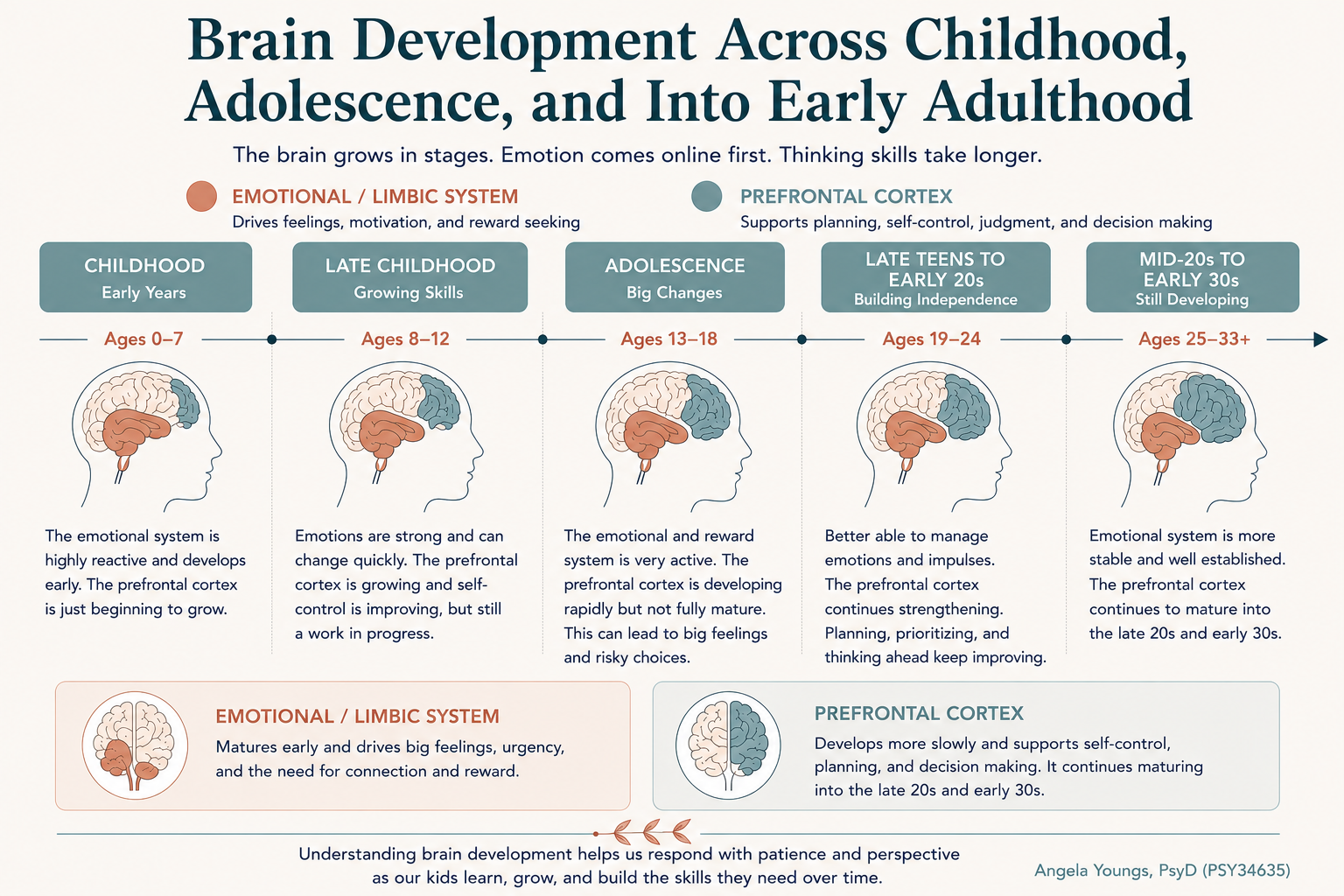
The brain's regulatory system is a long time in the making. The part of the brain responsible for reasoning, impulse control, and emotional regulation (the prefrontal cortex) is not fully developed until the mid-twenties or later, with some evidence suggesting development continues into the early thirties.
Meanwhile, the emotional and reward-processing systems of the brain mature much earlier. This gap is especially pronounced during adolescence, but the mismatch between big feelings and limited regulation capacity shows up across childhood in different ways at different ages.
This is how brains are built to develop. It is not a flaw in your child, nor is it something parenting could have bypassed. And it is why a child's nervous system continues to rely on a parent's well past the years when that might feel obvious.
What Co-Regulation Actually Looks Like
Co-regulation is not the same as permissiveness. It does not mean avoiding limits or agreeing with everything your child feels. It means attending to the emotional state before addressing the behavior or the problem.
In practice, this can look like:
Lowering your voice when your child raises theirs
Slowing down physically rather than matching their urgency
Naming what you observe ("It looks like this is really overwhelming") before offering any solution
Sitting with a moment of distress without filling it with words
Waiting to talk about consequences until things have settled
None of these are passive. They require intention, and often, restraint. But a child who feels met is far more receptive to guidance than one who feels managed.
The Hardest Part: Your Own Regulation
Here is the part that does not always make it into parenting books.
You cannot consistently give your child something you do not have access to yourself.
When your child is dysregulated, your own stress response kicks in. It is harder to stay calm when someone you love is in distress, especially when time is short, the behavior is frustrating, or the moment touches something in your own history.
A large-scale review of over 50 studies found that parental emotion regulation is one of the strongest predictors of effective co-regulation with children. What parents model in their own emotional responses, how they handle frustration, stress, and conflict, shapes children's developing capacity for those same skills.
Parents often ask how they should respond when their child becomes dysregulated. My answer sometimes surprises them: I turn the question back around and ask what helps them stay grounded in those moments, and whether they are actively protecting access to that.
Progress Over Perfection
Co-regulation is not about getting it right every time. It is about showing up consistently enough that your child's nervous system learns it can count on yours.
There will be moments when you escalate too. Moments when you reach for the logical conversation before your child is ready to have it. That is part of it. What matters more than any single interaction is the overall pattern. It matters whether a child experiences you, over time, as someone whose presence helps them settle.
The research points to that as one of the most significant factors in long-term emotional health and resilience.
If you are navigating a difficult stretch with your child or teen, or wondering how to better support their emotional development, I offer complimentary 15-minute consultations. It is a low-pressure way to talk through what you are seeing and whether working together might be a good fit.
This post is intended as general psychoeducational information and is not a substitute for individualized clinical guidance.
Sources
Coan, J. A., & Sbarra, D. A. (2015). Social baseline theory: The social regulation of risk and effort. Current Opinion in Psychology, 1, 87-91.
Damour, L. (2023). The emotional lives of teenagers: Raising connected, capable and compassionate adolescents. Allen & Unwin.
Hostinar, C. E., Sullivan, R. M., & Gunnar, M. R. (2014). Psychobiological mechanisms underlying the social buffering of the HPA axis. Psychological Bulletin, 140(1), 256-282.
Kerr, K. L., Ratliff, E. L., Cosgrove, K. T., Bodurka, J., Morris, A. S., & Simmons, W. K. (2019). Parental influences on neural mechanisms underlying emotion regulation. Trends in Neuroscience and Education, 16, 100118.
Siegel, D. J., & Bryson, T. P. (2011). The whole-brain child. Delacorte Press.
Sturman, D. A., & Moghaddam, B. (2011). The neurobiology of adolescence: Changes in brain architecture, functional dynamics, and behavioral tendencies. Neuroscience and Biobehavioral Reviews, 35(8), 1704-1712.
Wass, S., Greenwood, E., Esposito, G., Smith, C., Necef, I., & Phillips, E. (2024). Annual Research Review: Dynamic systems perspectives on coregulation and dysregulation during early development. Journal of Child Psychology and Psychiatry, 65(4), 481-507.
Zimmer-Gembeck, M. J., Rudolph, J., Kerin, J., & Bohadana-Brown, G. (2022). Parent emotional regulation: A meta-analytic review of its association with parenting and child adjustment. International Journal of Behavioral Development, 46(1), 63-82.
Angela Youngs, PsyD · Licensed Clinical Psychologist (PSY34635)
Angela Youngs Psychological Services · Pasadena, CA